
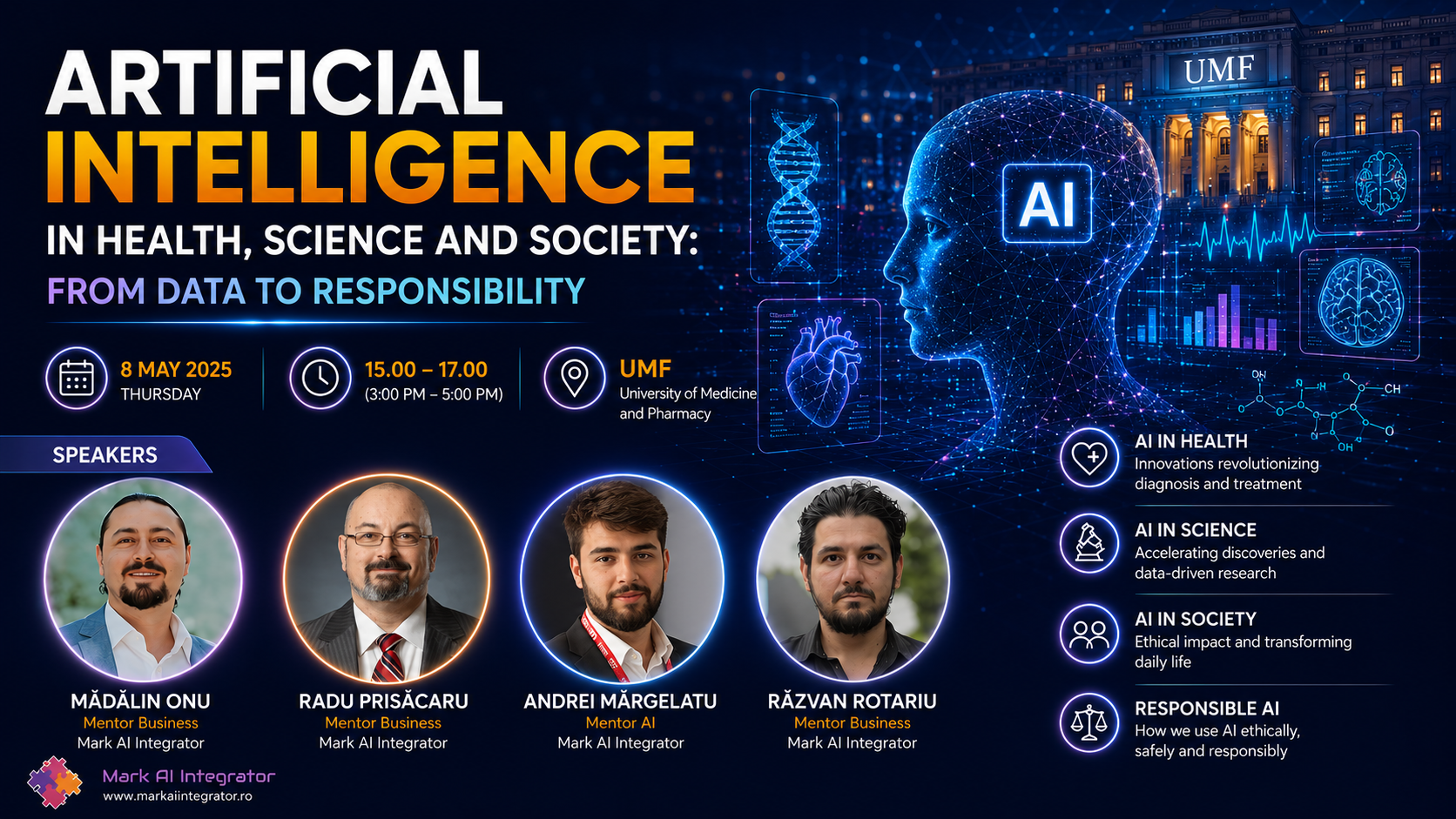

UMF Iași | May 8, 2026 | 15:00–17:00
On May 8, 2026, the University of Medicine and Pharmacy in Iași hosted a forward-looking event titled “Artificial Intelligence in Health, Science and Society: From Data to Responsibility.” Bringing together researchers, students, and industry voices, the event explored not only the technological power of AI, but also the ethical, social, and practical responsibilities that come with it.
From Data to Life-Saving Decisions
One of the most impactful sessions, delivered by Răzvan V. Rotariu, focused on how AI is transforming critical care medicine. His presentation, “Saving Lives in the Zero Hour,” highlighted how predictive analytics can detect early signs of sepsis and cardiac arrest. By analyzing real-time patient data, AI systems can identify subtle physiological changes long before they become visible to clinicians.
This shift from reactive to proactive medicine marks a fundamental transformation. Instead of responding to emergencies, healthcare professionals can intervene earlier, significantly improving survival rates. The session emphasized how AI is not replacing doctors, but augmenting their ability to act faster and more precisely.
AI and Early Cancer Detection
Another key topic was presented under the theme “Data Science in Medicine: How AI Models Are Built for Early Cancer Detection.” This session broke down the process of building machine learning models in healthcare, from data collection to evaluation.
Using medical data such as imaging, lab results, and clinical indicators, AI models can learn to distinguish between benign and malignant conditions. The presentation offered a practical perspective, showing how these tools are already contributing to earlier diagnosis and better patient outcomes. Importantly, it also highlighted the importance of data quality and ethical use in building reliable systems.
Beyond Technology: The Ethics of Care
A distinctive dimension of the event was introduced by Prof. Mădălin Onu, PhD, through his talk “Curator Beyond Protocol: The Emerging Figure of Care in Medicine and Research in the Age of AI.”
His perspective went beyond technical applications, exploring the philosophical roots of care in the context of AI. Drawing from the concept of curare—to care and to take responsibility—he argued that AI is reshaping not only how we treat patients, but also how we understand responsibility in knowledge systems.
As AI becomes more integrated into medicine and research, traditional roles evolve. The “curator” emerges as a figure who not only manages data, but also interprets meaning and ensures ethical responsibility in a world of overwhelming information.
From Learning to Building: AI Club for Students
The event also introduced a practical initiative led by Radu Prisăcaru: the AI Club for Students — Mark AI Integrator. Designed as a hands-on program, the club aims to move students beyond theory into real-world application.
Participants work in mixed teams, guided by mentors, to develop AI-powered solutions—from idea to MVP and prototype. The program culminates in pitching projects to a live audience and potential investors, offering a direct pathway into the regional AI Hackathon and Summit.
This initiative reflects a broader shift in education: from passive learning to active creation.
Conclusion
“Artificial Intelligence in Health, Science and Society” was more than a technical event—it was a conversation about responsibility. From life-saving medical applications to philosophical reflections and student innovation, the event highlighted a central idea:
AI is not just about data. It is about how we use that data to care, to decide, and ultimately, to shape the future of society.

Lasă un răspuns